When J.I. Packer considers lessons from the Puritans for the contemporary church he first points to “the integration of their daily lives”. “As their Christianity was all-embracing, so their living was all of a piece … There was for them no disjunction between sacred and secular; all creation, so far as they were concerned, was sacred, and all activities, of whatever kind, must be sanctified, that is, done to the glory of God”. By contrast contemporary Christians “tend to live un-planned lives at random in a series of noncommunicating compartments” and “feel swamped and distracted most of the time”.[1]
I take it that this loss of value of the everyday life is a pastoral problem which enervates discipleship and makes the Christian faith less attractive. In a culture where people are searching for meaning and purpose, we should be able to show how the Christian gospel offers that in the details of life, as well to a life overall. This article sets out a framework for considering a theology of everyday life from the perspective of the three-fold office of Christ. We can see the value and purpose of our everyday activities as we understand that Christ is king, prophet and priest for us. This offers a theological and Christological basis to address the pastoral problem. The conclusion offers some practical suggestions which flow from the theological framework.
SECULARISATION AND THE LOSS OF MEANING
Presumably, the loss Packer observes is a result of secularisation and a general loss of inherent meaning in the “immanent frame”.[2] In a famous speech in 1917, Max Weber (1864-1920) declared that with the rise of modern science “the world is disenchanted”. This not only removes spiritual realities as a frame of reference but strips human lives and activities of intrinsic importance or meaning.[3] It follows that we are left to create our own meaning. Our daily activities have the significance with which we invest them, and they retain it only as we are able to continue to make such an investment. We might add one further contribution to our quandary — our culture leads us to engage in most activities as consumers. So, we often seek unique experiences which we can invest with meaning. This limits our capacity to see routine as significant.
Christians may also struggle to find spiritual significance in their everyday activities due to the “sacred secular divide” (SSD).[4] This describes the pattern in which “life is divided into two compartments, the holy and the unholy, or the sacred and the profane”.[5] According to Greene,
SSD makes lay Christians think they are second-class Christians. It diminishes the value of their daily work, it blinds them to the fruit that God may be producing right where they are, it dulls their alertness to God’s action in their ordinary daily lives, and so it cuts them off from accessing prayer, wisdom, and the support of the body for their everyday contexts. And it blinds them to recognizing how the Bible addresses all of life.[6]
Greene and Billington do not relate their SSD diagnosis to Weberian disenchantment, yet there seems to be a connection.[7] In a disenchanted world, life is often divided between the public realm of activities that are significant in the shared “immanent frame”, and the private sphere in which we find personal meaning and significance. Religious activities are set in this private sphere. That suggests that for many Christians our family life can easily be related to our religious activities, but we struggle to see how other elements of daily life, especially our public roles of paid and unpaid work, are spiritually significant.
In this cultural context, Christians struggle to find spiritual significance in the routines of daily life. At least it is counter-cultural to do so. There have been some significant responses to this challenge in terms of a theology of work and vocation. I want to examine a wider category of “everyday life” which includes the daily (or at least regular) activities of home, community and leisure as well as work. These are activities common to Christians and non-Christians and not directly connected to church or devotional life.
CHRIST AND EVERYDAY LIFE
The general hortatory section of Colossians opens with instruction to continue to live (peripateō) in Christ Jesus as Lord, remaining in him, “strengthened in the faith … and overflowing with thankfulness” (Col 2:6-7). The section closes with a further call to thankfulness — “whatever you do, whether in word or deed, do it all in the name of the Lord Jesus, giving thanks to God the Father through him” (Col 3:17). This inclusio emphasises that all a Christian does should be marked by thanks to God. Further, the scope of the final instruction is all-embracing as the phrase “word” (logos) and “deed” (ergon) is a common way to refer to “the totality of one’s interaction with the world” (Luke 24:19; Acts 7:22; Rom 15:18; 2 Thess 2:17).[8]
To do all things “in the name of the Lord Jesus” is a similar idea to “living in Christ”. Believers are identified with Christ in baptism (Col 2:12) and have received fullness of in him (Col 2:10), they have died with him (Col 2:20), been raised with him (Col 3:1) and their lives are hidden with him in God (Col 3:2). They have a new identity in him (Col 3:9-11). So, their whole existence is defined by their salvation in and identity with Christ. “Since we have put on that Lord, becoming as a community the ‘new self’ who is none other than Jesus, the totality of our existence must now be lived out with him constantly in mind”.[9] The call to live thankfully “in Christ” in all activities indicates there is a Christological basis for the spiritually significance of all activities.
In light of these observations about Colossians and since Christology should be a co-ordinating doctrine in Christian thought, it is worthwhile to explore a Christological approach to everyday living, which would largely parallel a theology of work. [10]
I will use the munus triplex, or threefold office, to organise my reflections. That is Christ, as the redeemer (or mediator) holds an appointment by God to an office with three aspects — prophet, priest and king. He reveals God to us, he redeems and restores us to God, and he rules us for and as God. I do not assume this is the only way to structure an account of Christ and his work, nor that it is a comprehensive one.[11] However, it offers a broad, rich and integrated description of work of Christ which closely relates his person and work and from a redemptive historical perspective.[12]
CHRIST: KING OVER ALL OF LIFE
In the royal aspect of his office, Christ rules all of life. This provides the foundational theological perspective for the significance of everyday life.
Christ rules first as Creator. He is the image of the invisible God, the one who reveals the God who cannot be seen (John 1:18, Heb 1:3). He is the “firstborn” over creation, supreme over all creation because he is the agent of creation. All creation is his — “things in heaven and on earth, visible and invisible, whether thrones or powers or rulers or authorities” (Col 1:15). He is also the goal of the cosmos, all things are to be his (c.f. Eph 1:10). To name Christ as the “image” alludes to Genesis 1:26-28 in which humanity is made in God’s image to rule over the creation.[13] Colossians 1:15 shows that before humans are in God’s image, the eternal Son is the image of the Father. He not only displays the being of God but rules as God. In the incarnation Christ is also the full human “image of God”. So, each aspect of life and every dimension of existence is from Christ, ruled by him and has its purpose in him.[14] This Christological doctrine of creation challenges any assumption that there is a divide between domains so that Christ is more relevant for one than for others. It also calls us to see how every aspect of life is grounded in the creation patterns established by Christ.
Christ exercises his kingship by sustaining creation — “in him all things hold together” (Col 1:17 c.f. Heb 1:3). As God sustains creation he cares for the everyday needs of his creatures, providing rain and food (Pss 104:11–15, 27; 111:5; 136:25; 145; 15; 147:8-9; Jer 10:13; Amos 9:6; Matt 5:45; 6:25; Acts 14:17). The provisions of everyday life come from Christ.
Christ exercised his rule over creation in his earthly ministry. He calmed the storm (Matt 8:23–27; Mark 4:35–41; Luke 8:22–25), provided food (Matt 14:13-21; 15:32-39; Mark 6:32-44; 8:1-13; Luke 9:10-17; John 6:5-13) and wine (John 2:1-11), healed diseases (Matt 8:1-4; Mark 5:21-43; Luke 17:11-19; John 9:1-12; Acts 10:38), cast out evil spirits (Matt 8:28-34; Mark 1:21-28; Luke 8:26-39), and even raised the dead (Matt 9:18-26; Luke 7:11-17; John 11:38-44). Those works relate directly to Christ’s ministry as the Lord in redemption. He exercised his rule to restore creation and return it to the blessing of the kingdom of God. His miracles were evidence of the presence of the kingdom through him and in his work (Matt 12:28; Luke 10:9,11; 11:20).
Christ’s redemptive rule is equally part of Paul’s discussion in Colossians 1. God has not only reconciled all things to himself in Christ, but Christ has risen from the dead “so that in everything he might have the supremacy” (Col 1:18-20).
Like all of life, everyday life is disordered by sin. We do not live as image bearers working for the Lord and praising him in all we do. We turn everyday blessings into idols, while we receive others with thanklessness. We grumble and complain about everyday routines and are prone to laziness in them. We daydream of escape to a more exciting life. Our everyday practices often harm others and exploit the non-human creation, and because they are routine, we hardly notice their effects. We experience the days as a heavy burden (Eccl 1:13; 3:10) and a frustratingly fleeting moment (Job 7:7; Pss 39:4-5; 62:9; 89:47; 144:4; Eccl 7:15).
Christ’s restoring rule gives us a basis to discern the blessing in the original created goodness of the everyday and to receive it from him with thanks.
CHRIST: PROPHET TO ALL OF LIFE
As Christ reveals God, he speaks to us about our daily lives. This is true of Christ’s teaching in the Gospels, but we should look more widely to see the full scope of Christ’s prophetic ministry since all of Scripture is, ultimately, the word of Christ. To illustrate, I consider examples from biblical law, wisdom literature, Jesus teaching in the Gospels and the epistles.
Scripture offers a “monotheising” ethic consistent with the Christological unity of creation and redemption. The term is used by Morrow who identifies the “the underlying purpose” of OT law as enabling God’s people “to bring every sphere of life under the aegis of God”.[15] He terms this “monotheising”, since it works out the implication of Israel serving the one Lord. It captures well the theological dimension of the biblical moral vision.
The Shema — “Hear, O Israel: The LORD our God, the LORD is one. Love the LORD your God with all your heart and with all your soul and with all your strength” (Deut 6:4–5) — is a statement of monotheism and its ethical implications. It is not merely an assertion of abstract monotheism, its focus is that the Lord alone has saved Israel and taken her as his people. “He is unique, incomparable, and above all: he is the only God for Israel”.[16] Because the Lord their God is unique and uncontested as the true God, Israel must serve him with all they are in all their lives. Life is not separated or segmented between different powers or gods, rather all of Israel is called to love and fear the Lord with all that they are and have and do.
The next few verses stress the way in which the law of the Lord is to encompass all of life (Deut 6:6-9). It is to be on the hearts of the people (c.f. Deut 11:18-20; 30:6, 10, 14), planted in the centre of their inner life to direct their behaviour. They are to diligently teach the law to their children. They are to talk about the law at home and on the road, lying down and getting up — both of those instructions are merisms in which the parts embrace the whole. That is, the law is to be part of every moment and movement. Similarly, the law is to be tied to hand and head and written on door frames and gates, which is probably a metaphor for how the law is to be constantly present directing all their lives.[17]
Christ, in his incarnation, is identified in terms of the Shema (1 Cor 8:6).[18] The same moral vision of one God who made and rules the whole creation directs Christian living. On the basis of a monotheistic moral vision, Christ as prophet speaks to his people through Scripture about the full sweep of life, showing us how we love God and neighbour.
The law stated in principle in the Decalogue touches on a wide sweep of areas of life. The third command assumes that Israel in covenant with the Lord, always takes (tisa) his name, and insists it must not do that in way that is false or empty.[19] The people of God are to honour the Lord in all they do. The fourth commandment directs the use time, the following commandments deal with relationships to parents, protection of life, marital faithfulness, protection of property, legal process and a responsibility to tell the truth.[20]
Biblical law has social and economic concerns integrated with the theological call to love our neighbour (Lev 19:18).[21] It illustrates how living as God’s people will affect every aspect of life. Morrow observes in the law “matters typically divided between “sacred” and “secular” in the modern world stand closely together”.[22]
Biblical wisdom has the same monotheistic centre as the law: the fear of the Lord.[23] Wisdom is available to those who seek it in the fear of the Lord, and he alone is the Creator and Author of the order and structure which wisdom discerns. Jesus’ teaching in the synoptics expresses the same monotheism in terms of the kingdom of God. Disciples seek God’s kingdom first (Matt 6:33), pray for and long for the kingdom (Matt 5:6; 6:10).
Bartholomew and O’Dowd observe that the lack of apparent order in the Proverbs reflects their connection with everyday life. “Our lives are not orderly and topically arranged” and “the proverbs mirror this reality by stringing together groups of proverbs that sometimes have only vague interconnections”.[24] The semantic connections between the various proverbs presented alongside each other suggest insights into the complex structure of the created order and daily human life within it. “Proverb 8:2-3 goes out of its way to stress that the call of wisdom (cf. Prov 8:1) is heard everywhere in daily life: on the heights, beside the way, at the crossroads, beside the gates and at the entrance of the portals!”.[25]
The range of topics considered in Wisdom literature, especially the Proverbs, shows a serious concern with the details of everyday life. Proverbs deals with laziness and diligence (Prov 6:6-8; 10:4,5; 12:24; 19:15; 21:5; 24:30-34), speech (Prov 11:9; 13:2; 15:23; 18:20; Prov 12:6, 13, 14, 17, 18, 19, 22), friendship (Prov 14:20; 19:4, 6, 7; 17:17; 18:24; 27:10), and family life (Prov 10:1, 5; 12:4; 21:9,19; 23:2631:10).
Jesus similarly instructs his disciples to live for the kingdom in a range of areas of life: in relationships with enemies (Matt 5:21-26, 43-47; 18:15-17), in marriage (Matt 5:31-32; 19:3-12), with wealth (Matt 6:19-24), in responsibility to parents (Matt 15:3-6), and to care for the poor (Matt. 6:2–4; 19:21; Mark 10:21; Luke 11:41; 12:33; 14:13; 18:22; 19:8).
The household codes of New Testament epistles underline the extent to which Christian living involved every aspect of the life (Col 3:18–4:1 and Eph 5:22–33; 1 Tim 2:1–15; 5:1–2; 6:1–2, 17–19; Titus 2:1–3:8 and 1 Pet 2:13–3:7). The household was the key institution in Greco-Roman society. Work, education, leisure and home life were all part of the same domain. Saller highlights this with respect economic activity, “the Roman family was the primary site of production, reproduction, consumption and the intergenerational transmission of property and knowledge undergirding production in the Roman world”.[26] More generally, Rawson explains that “family” in some form “is a vital element of every aspect of Greek and Roman history”.[27] So, when the apostles instruct believers about life in the household as wife, husband, child, slave, or master, they comprehensively addressing everyday life.
CHRIST: PRIEST FOR ALL OF LIFE
As priest Christ reconciles us to God, sanctifies us and makes the whole of life a spiritual sacrifice to God.
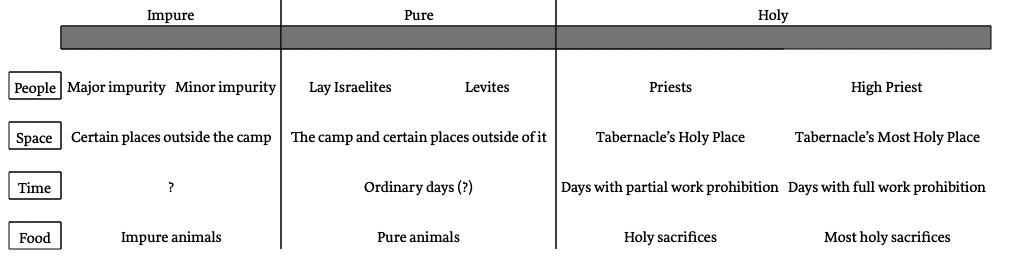
It may seem that a priestly perspective is most likely to differentiate between the sacred and the secular. The priests of Israel were to “distinguish between the holy [qodesh] and the common [chol], between the unclean [tame’] and the clean [tahor]” (Lev 10:10). Sklar summarises the range of ritual states in the Levitical law (see table below). Various people, places and times were holy, pure or impure. These were not moral states, but ritual states.
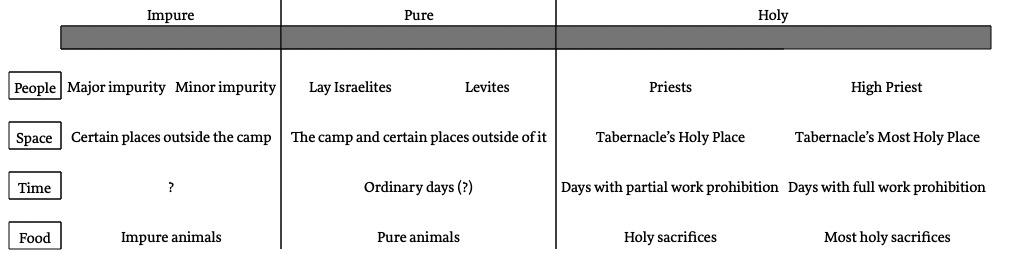
Sklar suggests that the ritual states and the movement between them had three purposes. They reinforced for the Israelites the significance of the Lord’s holiness — “all the laws related to ritual states were like the strokes of a pen, underlining again and again the sentence: ‘The Lord is holy!’”. Second, they showed that the people were to reflect the Lord’s holiness. Third, and perhaps rather surprisingly, “they were to serve as constant reminders to the Israelites that the Lord wanted them to be holy in all of life… from a moral perspective”. Sklar suggests that because the ritual distinctions were made in “many areas of their everyday life (meals, sickness, bodily processes), all of life became an opportunity for them to remember that they had been set apart as distinct to be the Lord’s holy people, reflecting his holy character to the watching world”.[28]
The Levitical ritual system also implied that it was not possible for all of life for all the people to be truly holy. The tabernacle/temple was the only place where Israel could worship the Lord in holiness and only the priests were ritually holy and able enter. Only the priests and their family could eat the sacred offering (Lev 22:1, 10-13; Num 18:19). The rest of Israel lived outside the tabernacle and temple and could only come to the entrance of the tent of meeting. Women were made unclean by menstruation (Lev 15:19), both husband and wife were unclean from sexual relations (Lev 15:18) and a woman was again unclean from childbirth (Lev 12:2). Any of these, meant that the person could not even approach the entrance of the tabernacle.
This temple exclusion contrasts with the eschatological conclusion of Zechariah, which expects a change in the ritual law with the day of the Lord (Zech 14:1). Then, even the bells of the horses (an unclean animal) will carry the same inscription as the turban of the high priest declaring them “Holy to the Lord” (Zech 14:20 c.f. Ex 28:36). Not only will the cooking pots in the temple become like sacred bowls before the altar, but every pot in Jerusalem and Judah will be holy, and everyone who comes to offer sacrifices will take the pots, and presumably the sacred offering in them, and cook and eat (Zech 14:21). This shows “the whole of Jerusalem and Judah as one vast sanctuary, in which everything is holy, from the explicitly religious vessels of the temple to the most common cooking pots … Everything is sanctified by God’s presence and partakes of his perfection”. [29] The gradations of holiness in the Levitical system will be removed in eschatological salvation.
Christ’s priestly ministry fulfils — and more than fulfils — the hope of the end of Zechariah. He consecrated himself to God as a priest and sacrifice, in his death and resurrection, so that those who believe in him are also consecrated (John 17:19).[30] He is also the true temple in whom the people of God live consecrated lives (John 1:14; 2:21-22; 4:21-23).
The church is in Christ, the true temple, and is built on him as the cornerstone The church is God’s temple, sanctified by the Holy Spirit for spiritual sacrifices to be offered to God (1 Cor 3:16–17; 2 Cor 6:14–7:1; Eph 2:2; 1 Pet 2:4-5).[31] At the same time believers are, corporately and individually, priests in Christ offering spiritual sacrifices (1 Pet 2:5,9; Rev 1:6; 5:10; 20:6).[32] The priestly ministry of Christ makes formal worship of the Lord a sacrifice of praise and prayer (Acts 10:4; Heb 13:15; Rev 5:8; 8:3). Generous partnership for the sake of the gospel (Phil 4:18) and doing good including generosity to others (Acts 10:4; Heb 13:16) are sacrifices. Martyrdom for Christ is also sacrifice (Phil 2:17; 2 Tim 4:6; Rev 6:9). Yet the “spiritual sacrifices” of Christians are also general (1 Pet 2:5,9) and the language of spiritual sacrifice applies to the whole of Christian living.[33] Paul’s priestly ministry in preaching the gospel means that Gentiles themselves become an offering acceptable to the Lord (Rom 15:16-17). In Romans 12:1 the whole life of bodily service to the Lord with a transformed mind devoted to the will of God is “true and proper worship” (logikos latreia).[34]
The end of the food laws indicates the sanctification of the whole of life as worship in Christ. As noted above, the Levitical law required Israel and her priests to maintain the distinctions between holy, clean and unclean. Priests could not perform their ministry if they became unclean, and those who were not priests could only come to the entrance of the tent of meeting or the temple courtyard. They could never enter the holy places, as they could not be holy. Now all who are in Christ are holy and are appointed as priests. They do not have to avoid unclean food or activities. Christ declared all food clean (Mark 7:19) and there is no need to abstain from foods. Rather, we recognise all that God has made is good and receive it with thanksgiving since it is consecrated (hagiazō) by the word of God and prayer (1 Tim 4:5).[35]
CHRIST FOR EVERYDAY LIFE
Each aspect of the work of Christ as king, prophet and priest brings significance to everyday life. At this point I will integrate these themes and suggest some steps to realise this in life and ministry.
Christ’s royal office unites creation and redemption. Just as Christ is the Creator and Sustainer, the heir and goal of creation; so in his death, resurrection and ascension he is Lord of all of creation. At the very heart of the Christian gospel is the claim that the Creator is the Redeemer, and so his work of redemption brings the whole created order to its fulfillment and perfection. The one who claims all of creation has reclaimed it in redemption. Thus, life in him is shaped by the patterns of the created order. Daily life deals with that created order and the human culture which has developed within it. Creation and culture have been distorted by sin — life in Christ enables and calls us to anticipate his full redemption. Life in Christ must discern how we live a full human life, reflecting Christ’s creative purposes in the whole range of activities.
Preaching and teaching this theological vision should provide people in our churches with the basis for integrating all of life as discipleship. Dallas Willard argues that genuine discipleship requires us to grasp Jesus’ view of the world, and “to his eyes this is a God-bathed and God-permeated world”.[36] A recent example of this is a meditation by Andrew Prideaux on swimming in the surf as it brings him “into the light, wind and water of the One who made it and his own life”.[37]
Christ’s prophetic ministry shows the content of a daily life ruled by him. Biblical ethics, in various ways, describes a life which is unified by its Christological theo-centricity. We are to love God, fear him, seek his kingdom, and do all things in the name of Christ the Lord. Life has an ethical simplicity, because all of it a setting in which we are to love God and love our neighbours.
Within this simplicity, biblical ethics address a vast range of activities. Teaching and preaching should spell out the implications of biblical law and wisdom, as well as Jesus’ teaching and instructions of the epistles, for all sorts of areas of life. Given the riches of biblical revelation in relation to everyday life there is no excuse for the predictable applications of “read the Bible, pray and share the gospel”.
Preachers should help us see the connections between biblical teaching and the details of life and help us to explore those connections in our own Bible reading. Preaching on biblical law and wisdom may particularly help to show these connections. This reinforces Hussey’s call for “whole of life preachers” who see how the Bible speaks to all of life, who are themselves sensitive to the various contexts in which their congregations live, and who ask about the various times and places and ways in which a text could apply.[38]
If we believe that the Bible speaks to everyday life, then we should include serious discussion about “everyday life” as part of our discipleship and pastoral care and connect those discussions with Scripture. I suspect many people in our churches will enjoy learning to do this and will find it encouraging and even liberating. The Complete Book of Everyday Christianity is a stimulating resource on this. Each short article on an aspect or issue of daily living is a reminder of ways Scripture speaks to life (and read the article on chocolate).[39] This material can be the basis for many forms of Christian education— small group discussions, seminars, workshops, podcasts, and conferences.
Christ’s priestly ministry means that every part of life is lived in his holy temple and is an opportunity to offer spiritual sacrifices to God through him. Our lives are consecrated to God in Christ through the word of God and prayer. We experience daily activities as worship as our imaginations are shaped by Scripture and we live prayerfully. We offer spiritual sacrifices as we receive God’s good gifts (people, objects and opportunities) with thanks, seek to love and serve him with those gifts and to serve those around us. Every Moment Holy offers “liturgies for the ordinary events of daily life” with about 100 short prayers for everything from preparing a hurried meal, coveting technology, setting up a Christmas tree and changing a nappy.[40] These can be a basis for personal prayers, and for prayer in public worship.
The discussion has followed some of the lines of recent theology of work. Yet theology of everyday life is a complement for this, and should frame the consideration of “work”. Theology of work risks producing “a Christianized version of careerism”.[41] A theology of everyday life challenges the late-modern veneration of paid employment and insists that we serve the Lord in domestic chores, that we follow his teaching as we care for a sick neighbour, and that we offer him thankful worship in recreation as much as in our occupation. In Christ, every avocation is a vocation.
In a culture which has lost a sense of the sacredness of the everyday — the Christian gospel shows us that in Christ God has sanctified every moment and movement of the average day. We can and should “do everything in the name of the Lord Jesus”.
J.I. Packer, “Introduction”, to Leland Ryken, Worldly Saints: The Puritans As They Really Were (Grand Rapids, Michigan: Zondervan, 1986), 9. In his discussion Ryken, 333-37 makes this point at length, “Puritanism was impelled by the insight that all of life is God’s”. Thomas Goodwin wrote that from his conversion, “the glory of the great God was set up in my heart, as the square and rule of each and every particular practice”. John Cotton, similarly, explained that “not only my spiritual life, but even my civil life in this world, all the life I live, is by the faith of the Son of God: he exempts no life from the agency of his faith”. For George Swinnock the Christian tradesman knows that “his shop as well as his chapel is holy ground”. Richard Steele was sure that a Christian could exercise “grace in his calling”.
See Charles Taylor, A Secular Age. (Cambridge, Massachusetts: Harvard University Press, 2009)
Max Weber, “Science as a Vocation”, Daedalus 87.1 (Winter, 1958): 111-134 reprinted from From Max Weber: Essays in Sociology, trans. & eds H. H. Gerth and C. Wright Mills (Oxford: OUP, 1946), 134-156.
See M. Greene, “Theological Education and Disciple-making Church Leaders” in Transforming Vocation — Connecting Theology, Church, and the Workplace for a Flourishing World, eds David Benson, Kara Martin and Andrew Sloane (Eugene, Oregon: Wipf and Stock Publishers, 2021), xiii-xxiii, and explored in the volume produced by LICC, Mark Greene, Ian J. Sha, eds., Whole-Life Mission for the Whole Church: Overcoming the Sacred-Secular Divide through Theological Education (Langham Global Library, 2021).* ProQuest Ebook Central*, https://ebookcentral-proquest-com.theoref.idm.oclc.org/lib/dtl/detail.action?docID=6521244.
Buxton, Celebrating Life, 4, quoted in A. Billington “Naming the Issue from Scripture”, ch 2. in Whole-Life Mission.
Greene, xiv.
Billington comments that SSD does not refer to secular as “secularization, the theory which holds that as societies modernize they become less ‘religious’ – which has proven not to be the case after all”, Billington “Naming the Issue from Scripture”.
D. J. Moo, The Letters to the Colossians and to Philemon (Grand Rapids, Michigan: Eerdmans, 2008), 290.
Moo, 291.
It is concerning that when Sloane and Martin catalogue approaches to theology of work they do not find a Christological approach. Kara Martin, Andrew Sloane “A Brief Overview of the Faith and Work Movement” Transforming Vocation, ch 1 c.f. Stevens, Work Matters, 2–4. They categorise the approaches as Trinitarian, Creation, Image of God, Curse theologies (i.e. “our work is impacted by the curse”), New creation, Vocation, Spirit, Kingdom theologies, Heaven / end-times, Mission and Formational theologies.
A.J. Johnson, “Munus triplex”, T&T Clark Companion to Atonement, ed. A. Johnson (London: Bloomsbury, 2017), 656-58 argues that while the framework is elegant and useful it is “too constricting” to offer “sufficient conceptual unity”. He suggests that the three-fold office fails to represent important OT offices and images — husband, wise man, shepherd, kinsman-redeemer; and cannot integrate all the NT salvation imagery. He observes that Calvin made use of this approach but was not limited to it. While Johnson is right that the munus triplex cannot include all the biblical material, it is the broadest organising pattern available for the work of Christ. It includes more material than he allows, for instance the shepherd is a kingly image, and the wisdom teacher is both royal and prophetic.
On Christ’s three-fold office see R.J. Sherman, King, Priest, and Prophet: A Trinitarian Theology of Atonement (London: Bloomsbury, 2004); D.T. Williams, “Towards a Unified Theory of the Atonement” The Atonement Debate, ed. D. Tidball et al (Grand Rapids, Michigan: Zondervan, 2008), 228-246; A.J. Johnson, “Munus triplex”, 656-58; Cornelis van der Kooi and Gijsbert van den Brink, Christian Dogmatics: An Introduction, R. Bruinsma, trans. J.D. Bratt (Grand Rapids, Michigan: Eerdmans, 2017), 449–453.
“Humankind is in the image of God but also serves as the image. Humans have resemblance to God, even if limited, but stand in God’s place in the administration of God’s creation”, E. H. Merrill, “Image of God,” Dictionary of the Old Testament: Pentateuch, eds T. Desmond Alexander and David W. Baker (Downers Grove, Illinois: IVP, 2003), 444.
See further D.J. Moo, The Letters to the Colossians and to Philemon (Grand Rapids, Michigan: Eerdmans, 2008), 120.
W. Morrow, An Introduction to Biblical Law (Grand Rapids, Michigan: Eerdmans, 2017), https://www.perlego.com/book/2015402/an-introduction-to-biblical-law-pdf.
Arnold Huijgen, “Traces of the Trinity in the Old Testament: From Individual Texts to the Nature of Revelation” IJST 19/ 3 (July 2017), 263.
This is an implication of the instructions, whether we take “these words [devarim] that I give you today” as a reference to the Shema, the Decalogue, all the teaching to Dt 11:18-20, or the whole of Deuteronomy, see E.J. Woods, Deuteronomy (Downers Grove, Illinois: IVP, 2011), 137.
Roy E. Ciampa and Brian S. Rosner, The First Letter to the Corinthians (Grand Rapids, Michigan: Eerdmans, 2010), 382-85.
“Central to the thought of this commandment is the position of Israel in relation to God … Bearing the name or character of God was intrinsic to that role, and any false profession would mean a repudiation of the covenant relationship itself.” A. Harman “The Interpretation of the Third Commandment” RTR 47 (Jan-Ap 1988): 7.
“The commandment against coveting is, by its very character, the vehicle that opens up the Commandments as a whole to a broader understanding. It is a guard against an internal, private or feeling that tends to erupt into public and violent acts against one’s neighbour … As it moves into the sphere of attitudes and inner desires … the commandment sets the mind and hear as subjects of moral direction and ethical reflection”, Miller, Patrick D. The Ten Commandments. Westminster John Knox Press, 2009, 241.
C.J.H. Wright, Old Testament Ethics for the People of God (Downers Grove, Illinois: IVP, 2004), 17-85.
Morrow, 252. This discussion of the law assumes that while aspects of the law do not apply to Christians, it continues to shape the Christian moral vision.
The phrase “the fear of the Lord” is “carefully embedded in the structure and theology of the wisdom books”. At the start of Proverbs, it is announced “as the beginning of knowledge (wisdom)” (Prov 1:7) and “appears thirteen more times, at key places in the structure of the book”. It “appears in modified forms in Job 28:28 and Ecclesiastes 12:13”. C. Bartholomew, R. O’Dowd, Old Testament Wisdom Literature (Downers Grove, Illinois: IVP, 2014), ch 1.
Bartholomew & O’Dowd, ch 2.
Bartholomew & O’Dowd, ch 11.
R. Saller, “The Roman Family as Productive Unit” in A Companion to Families in the Greek and Roman Worlds, ed. B. Rawson (Hoboken, New Jersey: Wiley-Blackwell, 2011), 87.
B. Rawson, “Introduction: Families in the Greek and Roman Worlds”, in A Companion to Families in the Greek and Roman Worlds, ed. B. Rawson (Hoboken, New Jersey: Wiley-Blackwell, 2011), 3.
Jay Sklar, Leviticus: An Introduction and Commentary (Downers Grove, Illinois: IVP, 2013), 48–49.
A.E. Hill, Haggai, Zechariah and Malachi: An Introduction and Commentary, (Downers Grove, Illinois: IVP, 2012), 272–273, quote from B. G. Webb, The Message of Zechariah (IVP, 2003).
D. A. Carson, The Gospel according to John, The Pillar New Testament Commentary (Grand Rapids, Michigan: Eerdmans, 1991), 567.
R. J. McKelvey, “Temple,” in New Dictionary of Biblical Theology, eds T. Desmond Alexander and Brian S. Rosner (Downers Grove, Illinois: IVP, 2000), 809–810, electronic ed.
P. Ellingworth, “Priests,” in New Dictionary of Biblical Theology, eds T. Desmond Alexander and Brian S. Rosner (Downers Grove, Illinois: IVP, 2000), 700, electronic ed.
Richardson, Philip, “What Are the Spiritual Sacrifices of 1 Peter 2:5? Some Light from Philo of Alexandria,” Evangelical Quarterly 87.1 (January 2015): 3–17 suggests on the basis of parallels with Philo, that the original readers of the epistle would have understood Peter’s exhortations (1 Pet 1:13-14, 22; 2:1,11; 3:4, 8) as description of spiritual sacrifices.
R. T. Beckwith, “Sacrifice,” in New Dictionary of Biblical Theology, eds T. Desmond Alexander and Brian S. Rosner (Downers Grove, Illinois: IVP, 2000), 761, electronic ed.
On the other hand, for Christians the ceremonial meals of the temple have no spiritual significance and offer no special benefit. The writer of Hebrews calls on his readers to avoid being carried away with “all kinds of strange teachings” which advocate the importance of eating to strengthen their hearts (Heb 13:9). Lane concludes that the author is countering a teaching that “ultimately one can thank God fully for redemption only through the thank offering and the fellowship meal in the presence of the altar in Jerusalem”, W. Lane, Hebrews 9-13, Volume 47B. (Zondervan, 2017, 1st published 1991). He points out that “to strengthen the heart” was a common phrase for “observing a meal time”, and it could be that the readers of the epistle are at risk of viewing meal times as opportunities for particular spiritual blessing. The word for food (brōma) is not a technical term for ceremonial food. Yet the passage goes on to draw the contrast between Christians and those who minister, or worship, (latreuontes) at the tabernacle (Heb 13:10). The epistle has already stated that the gifts (dōron) and sacrifices (thusia) offered in the temple were unable “to clear the conscience of the worshiper” (latreuonta), but only concern food (brōma) and drink (poma) and washings (baptismos) (Heb 9:9-10). This suggests strongly that the contrast in chapter 13 is between eating sacrificial meals (or perhaps some imitation of these practiced by Jewish diaspora). Paul makes a similar point that “the kingdom of God is not a matter of eating and drinking, but of righteousness, peace and joy in the Holy Spirit” (Rom 14:17).
Dallas Willard, The Divine Conspiracy: Rediscovering Our Hidden Life In God (San Francisco: Harper Collins, 1997), 101-47.
A. Prideaux, “The Call of the Deep”, 24/11/2021 https://au.thegospelcoalition.org/article/the-call-of-the-deep/
Ian Hussey, “Preaching for the Whole of Life,” The Journal of the Evangelical Homiletics Society 20.1 (March 2020): 65–84.
Robert Banks and R. Paul Stevens eds, The Complete Book of Everyday Christianity (Singapore: Graceworks, 2011).
D.K. McKelvey, Every Moment Holy: Volume One (Nashville, Tennessee: Rabbit Room Press, 2017). For a list of the topics see https://www.everymomentholy.com/content#v1 , and see further volumes Vol. 2: Death, Grief, and Hope (2021) and Vol 3: The Work of the People (2023).
L. Ryken “‘Some Kind of Life to Which We Are Called of God:’ The Puritan Doctrine of Vocation” SBJT 22.1 (2018): 61.